
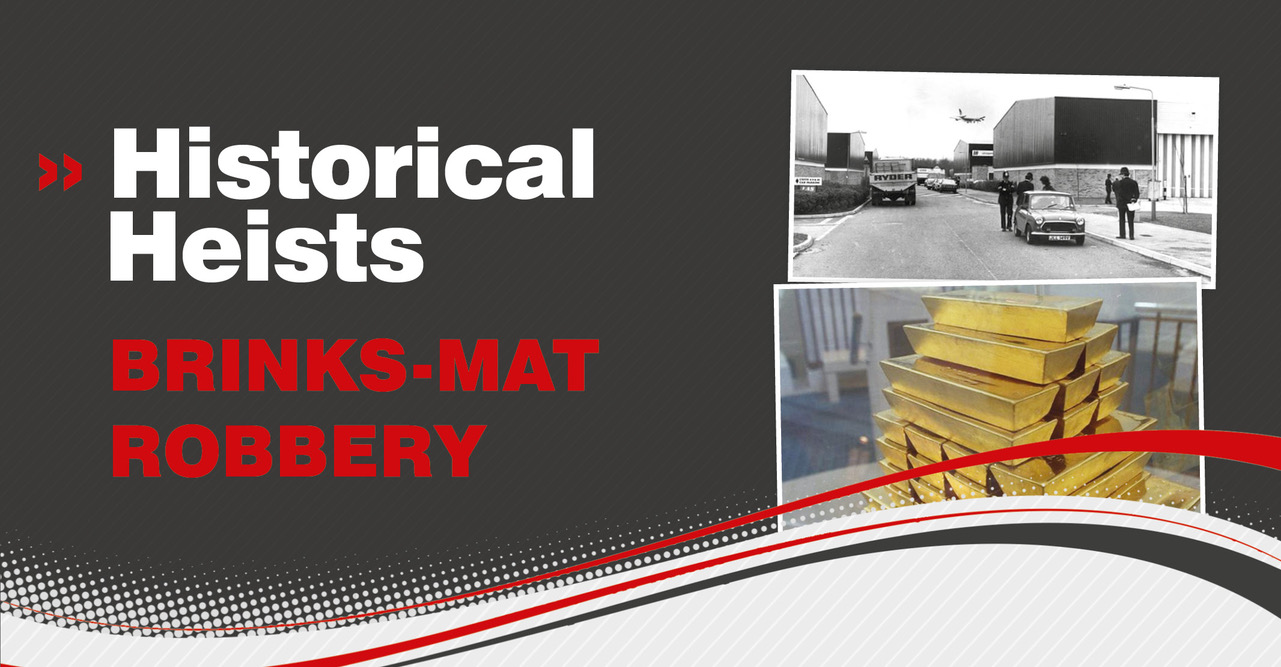
WHAT: BRINKS-MAT ROBBERY. WHEN: 26TH NOVEMBER 1983. WHERE: HEATHROW, LONDON.
This is the largest gold heist in British History
The Brinks-Mat robbery is a tale of a £26 Million gold and diamond heist. At 6:30am on the 26th November 1983, a south London gang of six armed robbers, headed by Brian Robinson and Mickey McAvoy, broke into the Brinks Mat warehouse at Heathrow Airport.
Their initial predictions led them to believe they would have walked away with £3 Million in cash. They had inside help from a security guard, Anthony Black, who happened to be living with Brian Robinson’s Sister at the time. The information given from Black gave them the quick access to site, where they encouraged the guards to give them the code for the safe, they poured petrol over them and threatened to set them on fire.
Black’s information also assisted them in disarming the electronic security systems, then they finally opened the safe.
When they opened the safe, they were expecting piles of easily transported cash, but instead this turned out to be 6,800 Gold bars which were divided into 76 cases weighing over three tonnes. There was also a stash of £100,000 worth of cut and uncut diamonds, all that could’ve been bound for the far east.
As they were expecting cash and easy getaway, they needed to change their getaway plan, so they sent some of the gang members to seek sturdier transport.
The gang used the warehouse’s forklift to load the gold into a getaway van, taking them almost two hours to clear the safe and its contents. By 8:15am they had left the warehouse and at 8:30am the alarm was raised by one of the guards.
The conversion of £26 Million worth of bullion into cash was proving a major issue for the gang, meaning they were forced to approach a senior underworld figure known as ‘The Fox’. He had connections with other gangs that would be able to smelt down and distribute the gold, specifically with the assistance of the Adams Family, who at the time were one of London’s most notorious crime syndicates. They recruited a jeweller named Sally Nahome, who agreed to sell on the smelted down goods.
December of 1984 McAvoy and Robinson were sentenced to 25 Years in prison. McAvoy realised that the game was up, so he entrusted a variety of friends with some of the gold for safekeeping, including one called Brian Perry.
Perry was subsequently arrested for handling the gold, ultimately feeling betrayed by McAvoy. Perry’s life was threatened during his trial, after failing to return the property, and after serving a nine year sentence, Perry was gunned down in November 2001 shortly after his release.
Perry recruited Kenneth Noye into the ever-growing circle of Brinks Mat associates. Noye had experience within the gold smelting trade, with links with the owner of a Bristol based gold dealership named John Palmer.
Noye intended on melting copper into the gold during the smelting process, which by altering its carat rating it would make it virtually untraceable.
They were caught after the gang withdrew £3 Million in cash from a single bank branch in Bristol.
January 1985, during an undercover operation, Noye discovered DC John Fordham was in his garden at his home in Kent. They got into a heated argument, and the officer was stabbed to death. Noye was arrested for murder but at his trial, the jury believed he acted in self defence, which was acquitted by a majority vote.
Following the discovery of 11 gold bars at his home, Noye was on trial again in 1986, along with Thomas Adams, which led to his conviction of conspiracy to handle Brinks Mat gold, in addition to VAT evasion charges. He received a 14 year prison sentence and was also fined a total of £700,000.
He was released in 1990 but after a road rage incident on the M25, he is now serving a life sentence.
Police estimate that there were over 15 people involved in the robbery, but only three of the gang members were ever convicted. Despite concerned efforts to bring the rest to justice and investigate work spanning two decades, the police have been forced to accept that the majority of the loot has been spirited away to foreign safety deposits or simply recycled into the wider London jewellery trade.
